
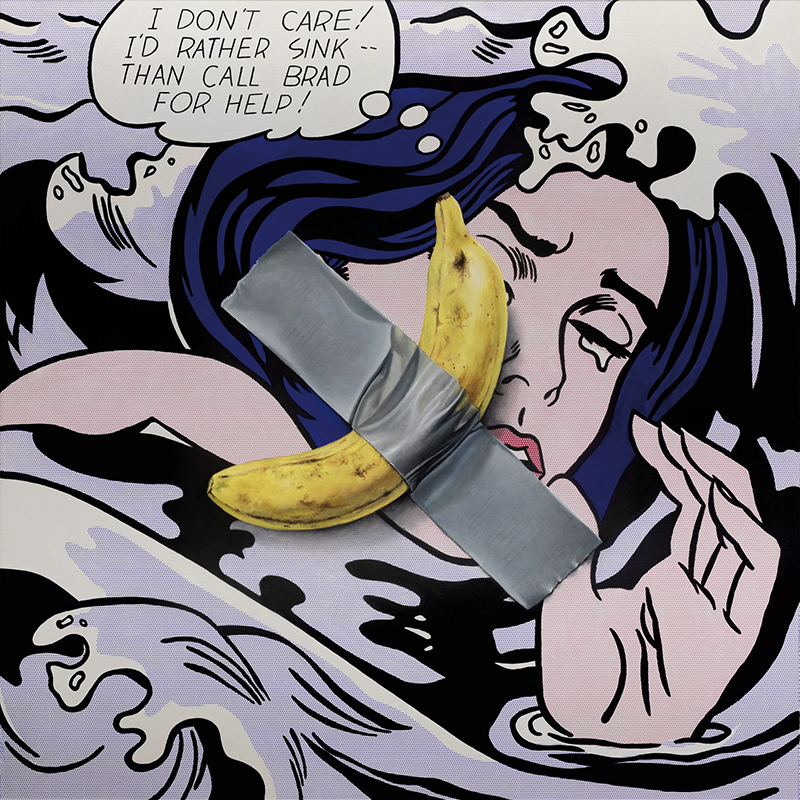
While Duchamp’s “readymades” had already removed the artist’s hand from making, Maurizio Cattelan went one step further by selecting an object requiring no human manufacture at all. Although Cattelan’s Comedian was initially received as a provocation, it marked a significant step in the evolution of art. A natural, indeed perishable, object acquired extraordinary value through context alone.
This exhibition takes that proposition as its point of departure, but not its conclusion. This body of work considers value as something assigned rather than inherent. Beginning with the proposition that an ordinary object can become art through designation alone, the series follows that idea into a range of cultural, political and historical contexts.
The works suggest that value is never fixed; it moves with context, authorship, belief, politics, institutions and time. And when value is malleable, it can be reassigned and reassessed. A banana can be recast as a porcelain artefact. Does taping an object to a masterpiece add or subtract value? Iconic paintings become sites of negotiation rather than fixed points of reverence.
Canonical artworks can be interrupted, everyday objects can be recast in materials usually reserved for monuments, familiar symbols are repaired, concealed or reconfigured, and historical narratives are measured against contemporary values. History itself is revalued as changing social attitudes reshape the meaning of images once accepted without question. Each work asks the same underlying question from a different direction - who decides what is worth preserving, celebrating or believing?
Rather than critiquing contemporary art, the exhibition examines the systems that produce cultural authority. Markets, museums, collectors, religion and national histories all rely on acts of collective belief. The works occupy the point at which those beliefs become visible. Whether value is created through skill, material, reputation, intervention or simple agreement remains unresolved, suggesting that the distinction between the priceless and the ordinary is less certain than we might like to believe.